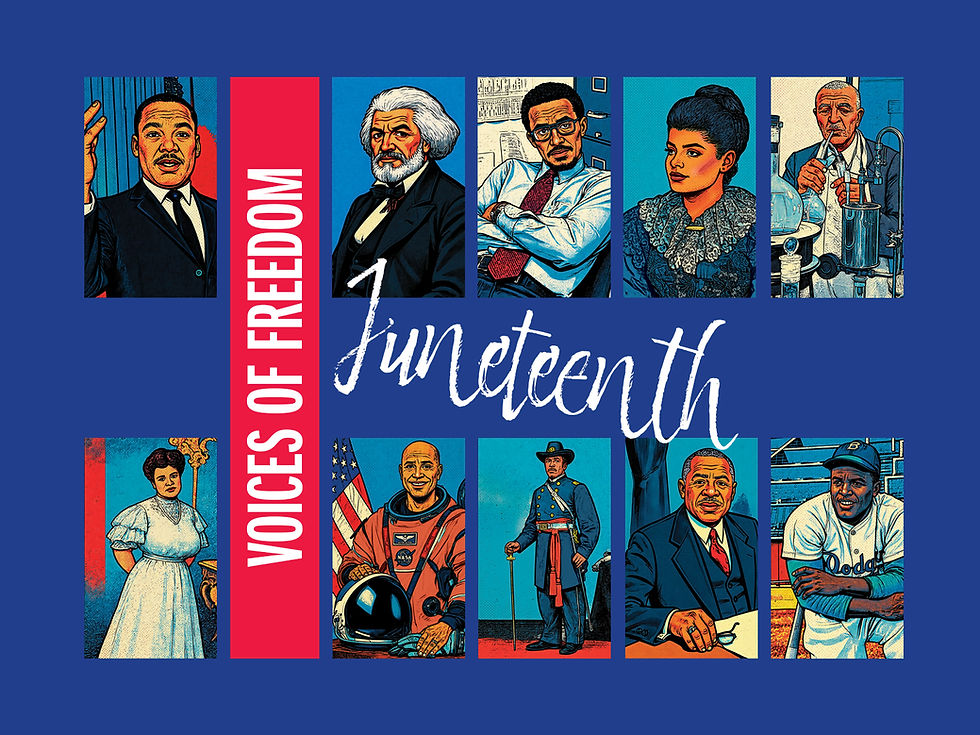
Voices of Freedom: Martin Delaney
Highlighting Juneteenth

Martin Delaney
(1812-1885)
Physician, Abolitionist, Soldier
“Every people should be the originators of their own destiny, the projectors of their own schemes, and creators of the events that lead to their destiny -- the consummation of their own desires.”

Martin Delaney was born in Charles Town, Virginia (now Charles Town, West Virginia), the son of Samuel and Pati Delaney. His father was enslaved but his mother was free, and Delaney inherited his mother’s status under Virginia law. His grandparents were Mandinkas born in Africa, who had been taken captive in a war and sold to slavers.
Pati Delaney taught her son to read, and in 1822 moved with him to Chambersburg, Pennsylvania, so he could go to school. In 1831, Delaney moved to Pittsburgh to further his education, and the following year apprenticed himself to Andrew McDowell, a white man who was an abolitionist and physician. In the following years, Delaney practiced medicine in Pittsburgh while writing for William Lloyd Garrison’s abolitionist newspaper The Liberator. After a break with Garrison in 1847, Delaney and Frederick Douglass co-founded the North Star, a newspaper run by blacks to promote abolitionism.
In 1850, Dr Delaney, after intensive study, was accepted into Harvard Medical School, but was expelled three weeks later after white students objected to having to share a classroom with a black man. Infuriated by this slap in the face, Dr Delaney began to promote the emigration of blacks to Africa. In the meantime, he continued to practice medicine in Pittsburgh. In 1854, he and a small band of nurses worked heroically to care for the victims of a cholera epidemic.
Dr Delaney promoted the emigration project. He traveled to Liberia, Nigeria, and England, and for a time settled in Chatham, Ontario, but returned to the United States at the outbreak of the Civil War. In 1863, he began to recruit black men for the Union army, ultimately helping to enlist thousands of men, among them his son, Toussaint Louverture Delaney. In 1865, he met with Abraham Lincoln to promote the idea of a corps manned and officered entirely by blacks. Lincoln, impressed by Dr Delaney and won over by his arguments, made him the first black man to be commissioned as a field officer in the US Army, with the rank of major. Major Delaney then lead black troops into Charleston, South Carolina, the birthplace of secession. Major Delaney in Charleston after the war’s end, serving briefly in the Freedman’s Bureau.
From then to his death in 1885, Dr Delaney remained active in his medical practice, as well as in politics, journalism, and business.