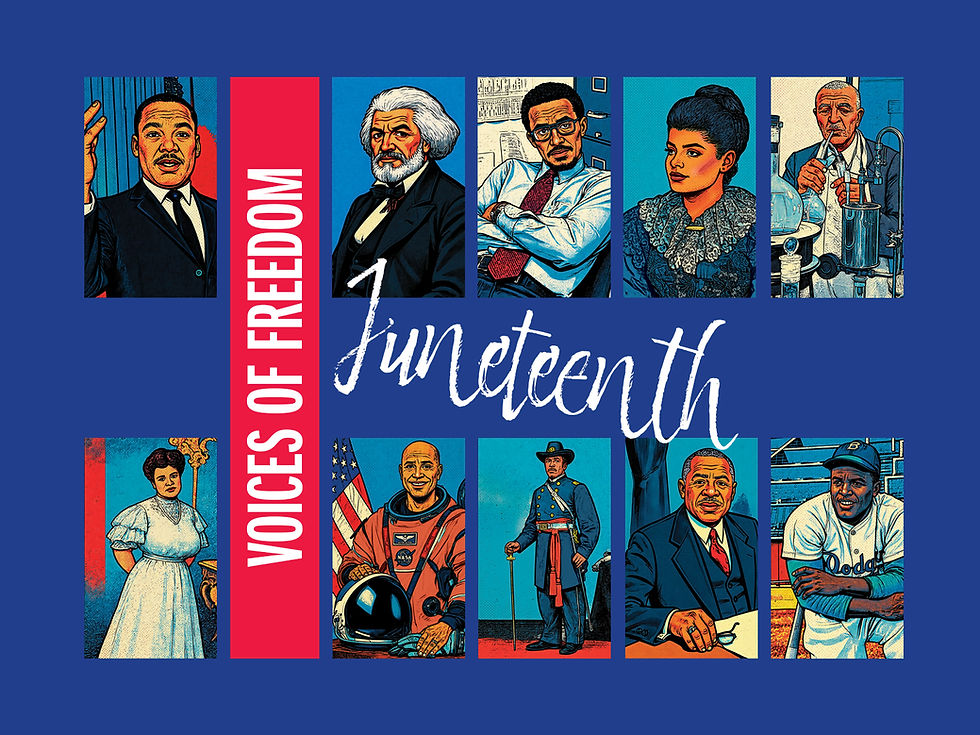
Voices of Freedom: Jackie Robinson
Highlighting Juneteenth

Jackie Robinson
(1919-1972)
Athlete, Writer
“I do not believe that every person, in every walk of life, can succeed in spite of any handicap. That would be perfection. But I do believe that what I was able to attain came to be because we put behind us (no matter how slowly) the dogmas of the past: to discover the truth of today; and perhaps the greatness of tomorrow.”

Jack Roosevelt “Jackie” Robinson was born in Cairo, Georgia, the son of Jerry and Mallie McGriff Robinson. His father left the family when he was one year old, and his mother moved the family to Pasadena, California, where Robinson grew up.
In high school, Robinson was a natural athlete: playing quarterback on the football team and shortstop and catcher on the baseball team, in addition to running track and playing basketball and tennis. After graduation, he attended Pasadena Junior College, starring in athletics and doing well in his studies.
In 1939, Robinson enrolled at UCLA, where he starred in track, baseball, basketball, and football.
In 1942, Robinson was drafted, and initially served at Fort Riley, Kansas. He was accepted into Officer Candidate School, though only after Joe Louis, who was also stationed at Fort Riley, protested the delays in processing his application. After receiving his commission, Robinson was assigned to Fort Hood, Texas; but a run-in with a racist bus driver led to Robinson’s being court martialed. He was acquitted, but the proceedings prevented his being deployed overseas with his unit. He was honorably discharged in November 1944.
On the advice of a player he met in the Army, Robinson joined the Kansas City Monarchs of the Negro American League. There, Robinson attracted the attention of Branch Rickey, president of the Brooklyn Dodgers, who was scouting black baseball players in order to break major-league baseball’s color bar. Robinson’s reputation for combativeness worried Rickey, who wanted a player who would, as he put it, “have the guts not to fight back” against the abuse to which he would be subjected. Robinson agreed, and was signed by Rickey to a minor-league contract with the AAA Montreal Royals.
In Canada, Robinson hit .349 and attracted more than a million fans to Royals games. In 1947, Robinson was called up the Dodgers. Assigned number 42, he made his major-league debut on April 11, 1947, in an exhibition game against the Yankees. Players on the St Louis Cardinals threatened to strike rather than play against Robinson, but baseball commissioner Happy Chandler and National League president Ford Frick declared that any players who refused to play against Robinson would be suspended. Opposing players barked racist taunts against Robinson, though some opposing players encouraged him, notably Jewish slugger Hank Greenberg.
Robinson was a fierce player. In the words of Leo Durocher, “He didn’t just come to play. He came to beat you.” In 1949, he batted .342, with 124 RBIs and 37 stolen bases; fans voted his to start in the All-Star Game, and he was named the National League’s Most Valuable Player.
In 1955, Robinson and the Dodgers won the World Series. By then, however, Robinson was suffering from the effects of diabetes. He retired in 1956, and was elected to the Hall of Fame in 1962.
After his retirement, Robinson worked as a sports announcer, while continuing to fight racist discrimination. He received many honors and awards.
Robinson died on October 27, 1972, from heart disease and the complications of diabetes. He was 53 years old.
The Kenosha Public Library has Jackie Robinson: An Intimate Portrait, by Rachel Robinson, his wife. Also available at the KPL is Robinson’s autobiography, I Never Had It Made.