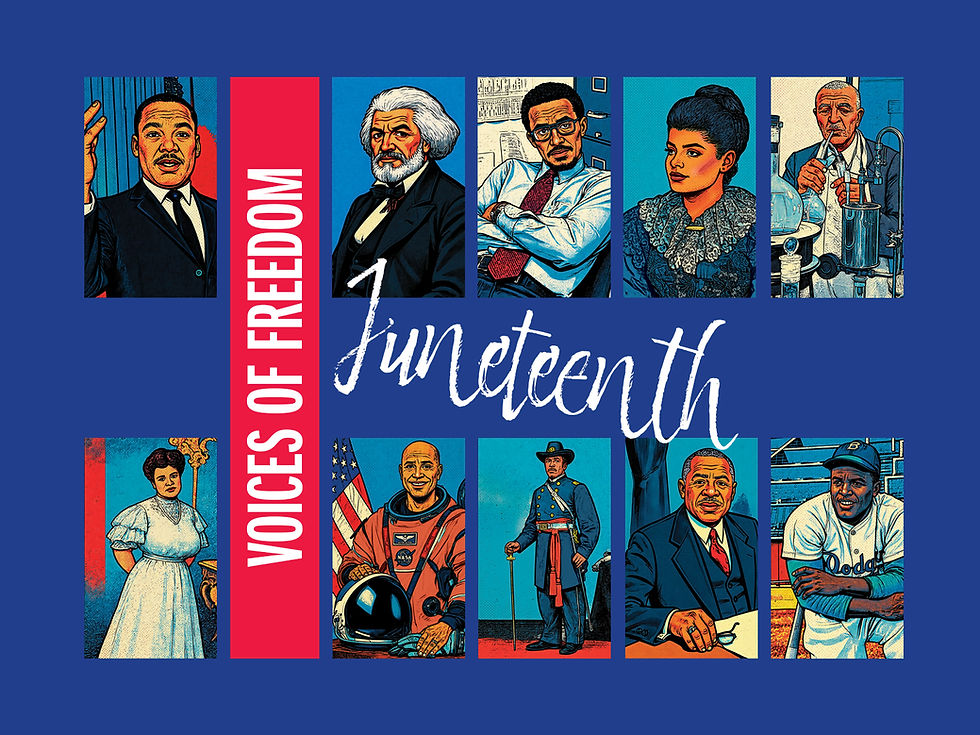
Voices of Freedom: Ida B. Wells
Highlighting Juneteenth

Ida B. Wells
(1862-1931)
Historian, Journalist
“The way to right wrongs is to turn the light of truth upon them.”

Ida Bell Wells-Barnett was born near Holly Springs, Mississippi, one of eight children of James Madison and Elizabeth Warrenton Wells. Born into slavery, she and her family were liberated in 1865.
Her father was a carpenter who ran a successful business and was committed to the Republican Party. However, in 1878, her parents and a brother died in an epidemic of yellow fever. The 16-year-old Wells resisted attempts to break up her family, and instead worked to keep them together by teaching school, first in Holly Springs and then in Memphis. At the same time, she studied at Fisk University and LeMoyne-Owen College, and began to write articles for black-owned publications, commenting on current events and attacking Jim Crow laws.
From the first, Wells was strong-willed, and intolerant of slights. A key incident occurred in 1884: when she refused to give up her seat on a crowded train, she was dragged from her seat and thrown off the train. She sued the railroad and initially won a settlement of $500, but the settlement was reversed by the Tennessee Supreme Court, which ordered Wells to pay court costs. This convinced Wells that for a black woman, justice was not to be had in Tennessee.
The murder of Wells’ friend Thomas Moss by a mob of whites, in what became known as the “People’s Grocery” incident, propelled Wells to investigate lynchings throughout the South. She collected facts, interviewed family members of victims, and compiled statistics for two major publications: Southern Horrors: Lynch Law in All Its Phases in 1892 and A Red Record in 1895.
In 1895, after a speaking tour in Britain that led to the founding of the world’s first anti-lynching society, Wells married Chicago attorney Ferdinand Lee Barnett, who was founder of the newspaper The Chicago Conservator. Wells settled in Chicago, and she and her husband became partners in her work—though at times she was distracted by the demands of her growing family.
In Chicago, Wells-Barnett was a founder of the Negro Fellowship League, a settlement house that worked with blacks. During the migration of blacks from the South during the First World War, the population of blacks in Chicago doubled during the 18 months between July 1916 and January 1918. Wells warned of impending trouble, particularly when Chicago police failed to arrest anyone for a series of bombings of homes purchased by blacks in neighborhoods of whites, leading up to the Chicago race riot of July/August 1919.
Wells-Barnett continued to work in Chicago, writing and organizing. She was a gadfly, outspoken and, at times, abrasive even to those on her own side. But her journalism, deeply researched and passionately presented, forced the nation to see the horrors of lynching.
Ida Wells-Barnett died in 1931 from kidney failure. Since her death, many honors have been bestowed on her memory.
You can borrow Ida Wells-Barnett’s The Light of Truth: Writings of an Anti-Lynching Crusader from the Kenosha Public Library. Please be warned that her descriptions of lynchings are horrifying and extremely upsetting to read.