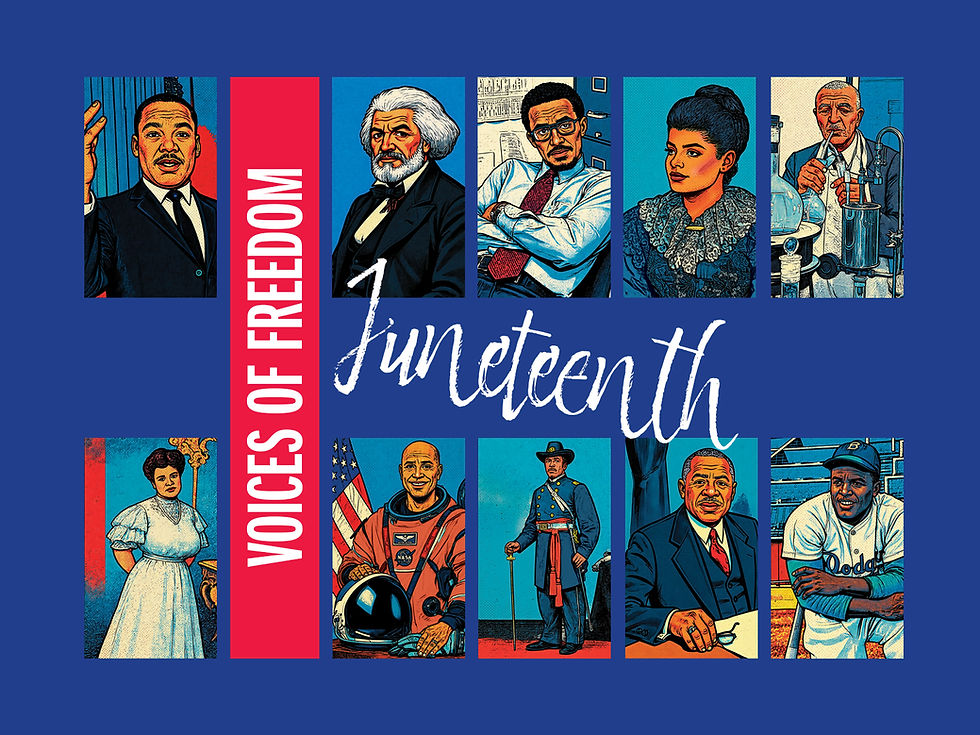
Voices of Freedom: Clarence Thomas
Highlighting Juneteenth

Clarence Thomas
(b. 1948)
Lawyer, Justice
“Today, now, it is time to move forward, a time to look for what is good in others, what is good in our country. It is time to see what we have in common, what we have to share as human beings and citizens.”

Clarence Thomas was born in Georgia, the child of M. C. and Leola Thomas. His father divorced his mother when when Thomas was three. Thomas was raised by his maternal grandfather, Myers Anderson, in a Gullah-speaking community near Savannah.
Myers Anderson, who owned a successful delivery business, influenced his grandson deeply. In the early 1960s, when Thomas was in junior high, Savannah was torn by demonstrations against racial segregation, Thomas used money from his business to assist jailed demonstrators and support the NAACP. At the same time, he did not spare Thomas, making him work hard during the summers and study hard at school. A convert to Catholicism, Anderson sent Thomas to Catholic high schools. As Thomas put it, his community treasured education “the way someone who is hungry treasures food.”
After graduating from high school, Thomas entered a Benedictine seminary, hoping to become a priest, but left after hearing seminarians make racist remarks on the assassination of Dr King. Instead, he went to the College of the Holy Cross in Massachusetts, on scholarship and working in the college dining hall. Thomas was a diligent student, but quiet and introverted. A native speaker of Gullah, he struggled with English, but majored in English literature, studying such black authors as Richard Wright and Malcolm X. In college, he flirted with leftism, but later became disillusioned with the left.
In 1971, Thomas graduated cum laude, and entered Yale Law School. There, he found the upper-class social environment at Yale difficult to fit into. Again, he worked hard, but quietly, and was awarded the degree of doctor of laws in 1974. After graduation, interviews with corporate law firms did not go well, the firms apparently assuming that Thomas got into Yale due to affirmative action, and therefore was not truly qualified as a lawyer.
Finally, he was offered a job by John Danforth, the attorney general of Missouri as an assistant attorney general. In Missouri, where he worked from 1974 to 1977, he worked on a variety of cases, gaining experience and expertise. In 1976, Danforth was elected to the United States Senate, Thomas joined him in Washington as a legislative assistant. In 1981, he joined the Reagan Administration, briefly in the Office for Civil Rights, then as chairman of the Equal Employment Opportunity Commission. Thomas served at the EEOC from 1982 to 1990.
In 1990, President George H. W. Bush nominated Thomas for the United States Court of Appeals, District of Columbia. Confirmed by the Senate, Thomas was active, authoring 19 opinions, and got along well with his colleagues, including Justice Ruth Bader Ginsburg.
In 1991, President Bush nominated Thomas for the United States Supreme Court, to replace retiring Justice Thurgood Marshall. After hearings marred by what Thomas called “a high-tech lynching”, he was confirmed by the Senate.
Since his confirmation, Justice Thomas has become the longest-sitting justice of the Supreme Court, and one of the most influential.
Clarence Thomas’s memoir, My Grandfather’s Son, is available from the Kenosha Public Library.