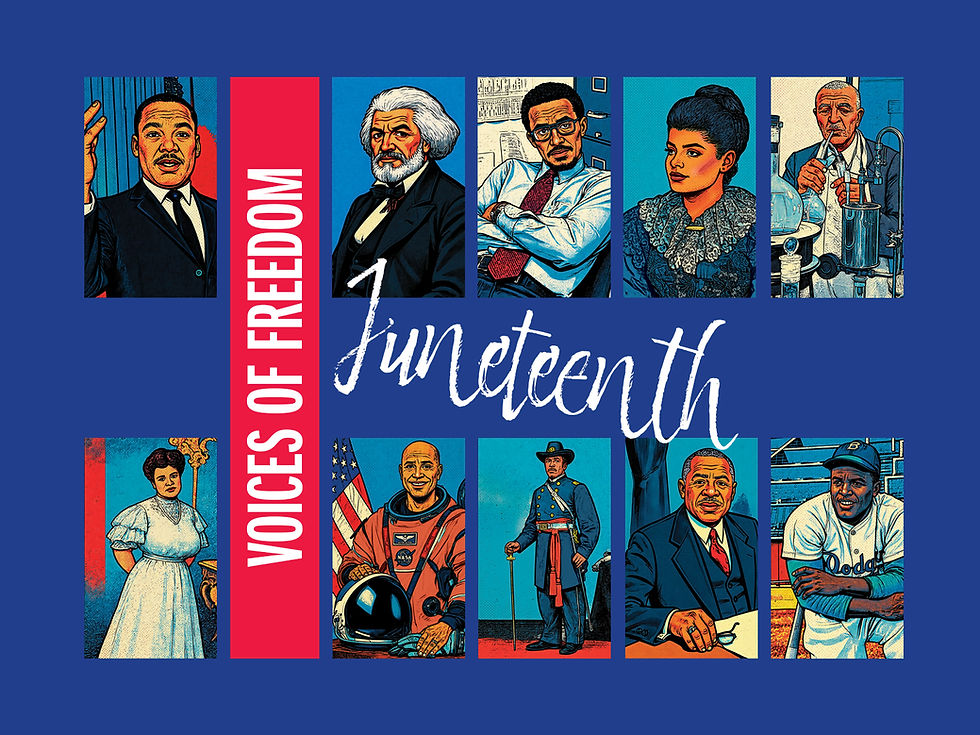
Voices of Freedom: W. E. B. Du Bois
Highlighting Juneteenth

W. E. B. Du Bois
(1868-1963)
Philosopher, Writer
“I believe that all men, black and brown, and white, are brothers, varying, through Time and Opportunity, in form and gift and feature, but differing in no essential particular, and alike in soul and in the possibility of infinite development.”

William Edward Burghardt (W. E. B.) Du Bois was born in Great Barrington, Massachusetts. His mother’s family were land-owning freemen of Dutch, English, and African ancestry who had long resided in Massachusetts. His paternal great-grandfather, James Du Bois, was of Huguenot descent. His father, Alfred Du Bois, abandoned the family when William was two years old. Her mother was assisted by family and friends, but suffered a stroke when William was in his early teens, and died when he was 17.
William grew up in an integrated community that helped him acquire an education. His attended Fisk University in Nashville, where he first experienced virulent racism. In 1888, he entered Harvard College, where he studied with noted philosopher and psychologist William James. He received his bachelor’s degree in 1890 and his master’s in 1892. That same year, he went on scholarship to Berlin, where he studied sociology. In Berlin, he had the experience of being treated “not as a curiosity, or something sub-human” but as just another student, no different from any other. In 1895, Harvard awarded him his doctorate.
After teaching at Wilberforce University and the University of Pennsylvania, Du Bois accepted a position at Atlanta University. There, he published his first major work, The Philadelphia Negro. In 1903, he published his best-known work, The Souls of Black Folk, a collection of essays.
Over the next six decades, Du Bois worked tirelessly. Highlights include his co-founding of the NAACP in 1910, the publication of three autobiographies, his promotion of the Pan-African movement, his fight against lynching and Jim Crow, and his publication of many scholarly papers and books. In 1935, he published his magnum opus, Black Reconstruction in America, in which he argued against the mainstream position that Reconstruction was a failure.
Du Bois was critical of Booker T. Washington’s “Atlanta Compromise,” though, as Thomas Sowell has pointed out, animosity was more between the followers of Washington and Du Bois than between the men themselves. Both emphasized the vital importance of education to the advancement of blacks. Although they are seen as opponents, in fact their strategies in the struggle against racism were complementary.
In his later years, Du Bois became an apologist for the Communist regimes of the Soviet Union and China. Among other stands, he supported Chinese suppression of the Tibetian revolt of 1959.
In 1960, he emigrated to Ghana at the invitation of its president, Kwame Nkrumah, and died there on August 27, 1963—the eve of the March on Washington. His remains are interred in Accra.
The Kenosha Public Library has available the Library of America’s anthology of W. E. B. Du Bois’s writings. It also has the Library of America’s edition of Black Reconstruction.